
Nearly 12 years ago, when first looking into participating whole life insurance as a financial asset and tool to manage my own investments, it was difficult to find any information on what participating whole life insurance was. It was even more difficult to locate any life insurance companies that still sold participating whole life insurance and that meant most life insurance agents were clueless on how participating whole life insurance can work for you, the owner, to increase your control over your cash flow and manage management in general.
Today, things have obviously changed. Google the words, Bank on Yourself, Infinite Banking, Personal Banking, and a slew of information pops up concerning cash value life insurance. The major obstacle today is a good obstacle in that it shows that the 1st amendment to our constitution is still at work today in our society. And that means there is so much information that now you have to determine for yourself what information is reliable and what information could be detrimental to you if you adhere to the recommendations provided.
Using cash value life insurance can be very beneficial for you financially if you want to have steady, tax-free, guaranteed annual growth on your money while providing income replacement at the same time.
If you own a business, or do any type of investing, the cash value that accumulates in a cash value life insurance policy can be used to finance normal business expenses or investments and you will earn a tax deduction on your personal taxes because the IRS allows the interest the insurance company charges for these purposes to be reported on your 1040 schedule A.
This deduction is something that has been used as a selling feature of cash value life insurance policies, but it may surprise you that it is not always in your best interest to over fund your life insurance policy in order to take advantage of the interest deduction. Especially if you are simply going to borrow against the policy immediately! As in all money management, it behooves you to consider the true costs involved with any transaction(s) and plan accordingly, before jumping in with both feet.
Another fact that is used to lure prospects into purchasing cash value life insurance is the interest earned on the cash values even while those cash values are leveraged and able to be used outside the policy. It is true that you can still earn an internal rate of return on your cash value life insurance policy even though you have a loan outstanding against it, especially with a non-direct recognition life insurance company. But here again, it pays to consider everything involved before you jump in the water. Simply knowing that you can earn an internal rate of return on your cash value while having a loan against your policy may not make borrowing against your policy always worthwhile. With policy loan interest rates, currently between 5-8% annually, and conventional loans running around 2-4% annually, it won’t take you long to realize that paying less interest is usually in your best interest. Yet here again, just as when selling the tax deductibility of policy loan interest, the growth you experience in the policy may not be significant enough to overcome the cost associated with the loan. Your path to a successful solution in either of these situations is to do the math. The math, properly calculated, will never lead you down a merry path to financial loss. So stick with the facts they will light the path leading to your best interest.
Following this advice will help you avoid the pitfalls of universal life insurance policies as well. These policies are based on a term product that has an annual cost. The annual cost of this insurance, is guaranteed to rise over the course of time. In fact, it will eventually overcome the growth which the policy can provide. That is when you, the policy owner, must decide to either drop the coverage or continue paying an ever-escalating price for insurance coverage. Regardless if they be, plain universal life, variable universal life or indexed universal life, the cost of your insurance coverage will go up over time and then all the accumulated cash value will be spent on premiums instead of being available for you to leverage or access.
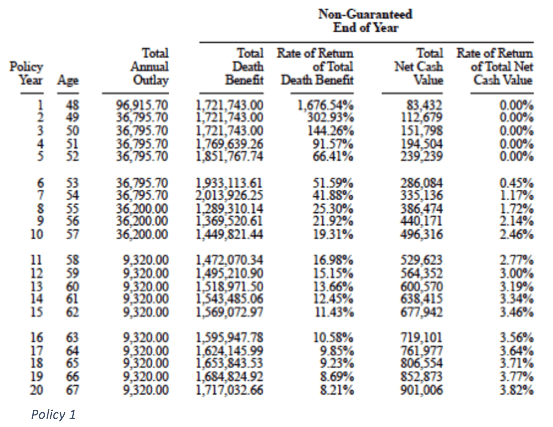 Another scheme used to sell high cash value life insurance is to bundle it up with a term insurance rider as seen here in Policy 1. Policy 1 has an annual premium of $9,320 and has been designed with a term rider that permits you to add an additional $87,595 dollars to the policy in the first year and variable amounts of premium over the following years, up to year 10, without getting the IRS all excited and taxing the policy’s growth (aka a modified endowment contract or MEC.) But as you can see as you study Policy 1, it provides only $83,432 of cash value in year one. That means you will have limited your cash flow by $4,163 immediately. If you plan on leveraging Policy 1’s cash value to use elsewhere, you will also be strapped with policy loan interest payments to the insurance company.
A more viable option would be to keep your cash on hand and purchase a policy for less money like in Policy 2. This would give you more control and use of capital without being subject to the additional cost of policy loan interest. In doing so, the questions should naturally arise, “Where else could I use this capital an earn a greater rate of return?”
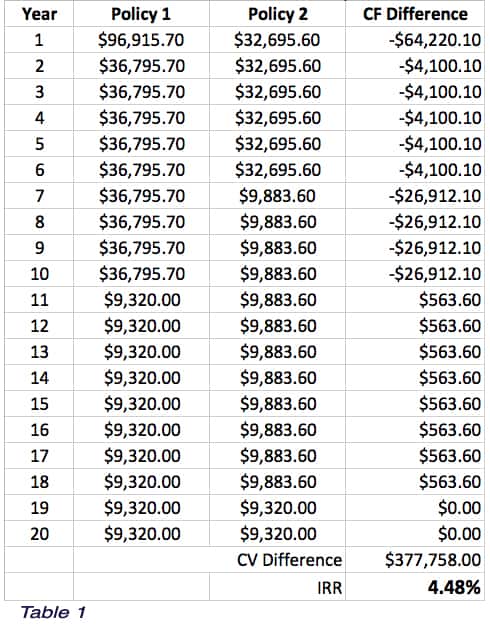
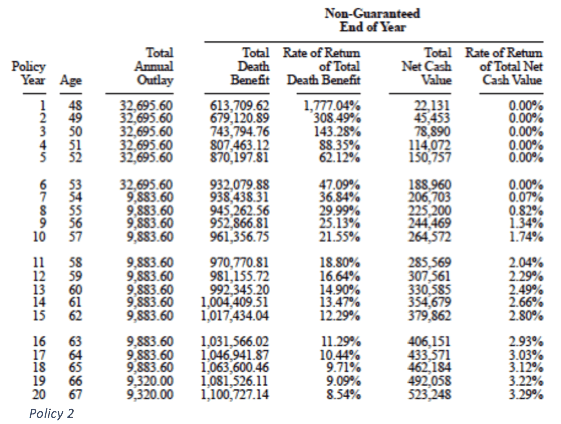 The answer to that question comes in knowing what you would actually have to earn to replace the internal rate of return earned in Policy 1 versus Policy 2.
Looking at Table 1 will show you exactly what you will need to earn to make that decision more profitable for you.
 Keep in mind, it is all about maintaining options with your money because you, nor anybody else who might be advising you, knows exactly what the future holds.
In this particular case, the policy owner was planning on investing cash value from a Policy 1 loan into real estate immediately. As he has a good track record with his rental properties, earning between 8% and 10% annually over the past few decades, it makes little sense for him to tie up money in Policy 1 when he could be earning a higher rate of return by purchasing another real estate investment. By doing so he will not only make more money (more than the 4.48%, the difference between Policy 1 and Policy 2), he will also avoid the cost of interest (somewhere around 4.7% annually) which would be owed on Policy 1 if he borrowed from it to fund his real estate purchase.
Of course, this option decreases the amount of life insurance coverage he will have compared to Policy 1, the participating whole life policy with the term rider added onto it. So, is there a way to avoid this decrease in coverage while still managing to keep more control of his vital cash flow? Obviously, there is, and here is that simple solution.
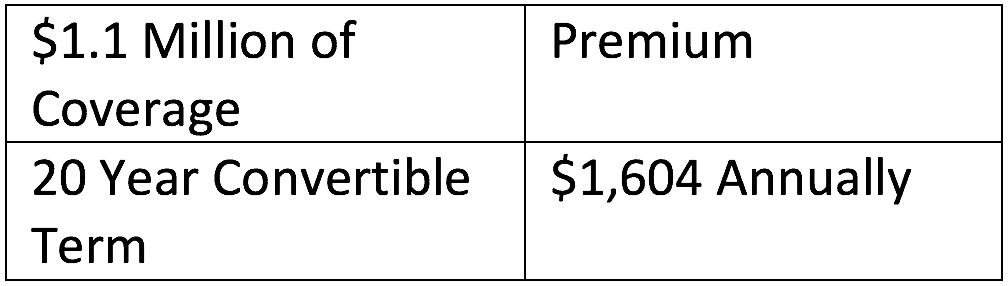
Purchase Policy 2 along with a separate term insurance policy. The cost will only be $32,080 over the first 20 years and more coverage will be provided than if only Policy 1 was purchased. $32,080 from $185,447 still leaves $153,367 of cash flow that would have gone to premium payments on Policy 1. And $153,367 can clearly earn a superior rate of return, outside, rather than inside Policy 1 as described above.
 All-in-all, term riders added to participating whole life insurance policies tend to:
So why do life insurance companies allow a term rider to be added to a whole life policy if there are better alternatives available for you to keep control of your money and have the coverage you need on your life?
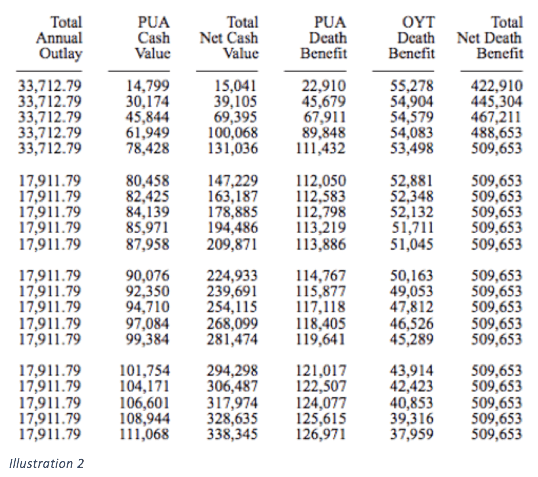
That answer lies in the fact that not all of us can receive the highest ratings or are as “young” as we would like to be when we apply for life insurance coverage. That being said, for someone who needs the coverage, but is highly rated, a term rider on a participating whole life insurance policy can be a God-send. Illustration 1 is a case of a rated 71-year-old who needed between $400,000 and $500,000 of coverage immediately. Sadly, he can’t afford the annual premium of $52,024 as illustrated here and so without adding a term rider as we did in Illustration 2, he would be left without the coverage he needs.
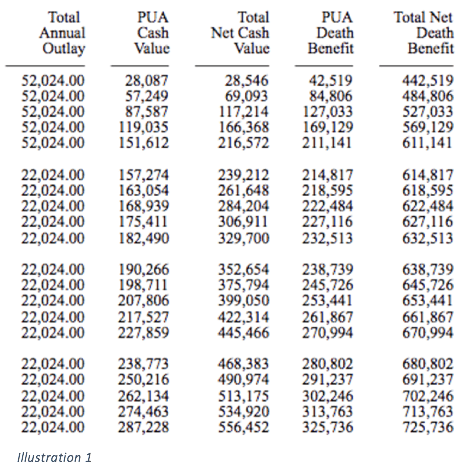 Appreciatively, the insurance companies realize similar situations and have provided an easy solution with the ability to add the term rider. By adding a term rider, this 71-year-old rated male can obtain the coverage he needs with an annual premium of only $33,713 not $52,024. That is a premium he can afford and is comfortable with. Granted his death benefit will never grow as high as in it could in Illustration 1, but his stated need for coverage was only $400,000 to $500,000 and the savings represented in Illustration 2 over Illustration 1 makes this doable for him. Without the term rider, insuring this rated 71-year-old would have been impossible.
 Overall, term insurance is a great product when it is used for obtaining the coverage you need to replace your income or when you need it to offset the cost of whole life insurance as shown above. But as you have now seen, using term insurance riders merely to increase the amount of money you can fund a participating whole life insurance policy with, may or may not be in your best interest. If you have any questions or concerns about putting “extra” money into a life insurance policy by adding a term rider, contact Life Benefits at 702-660-7000. We will be happy to do the math with you so that you can decide if such a scheme is a viable way to meet your needs and purposes. After all, it is your money and the decision of what to do with your money should by yours, and yours alone. Once you understand the math, you’ll easily be able to make that right choice for you intelligently.
At Life Benefits we don’t merely sell Life Insurance, we have your back. The precursor to earning more and keeping more of what you earn is accurate knowledge. By sharing accurate knowledge about how life insurance really works we hope to win and sustain your trust, respect and your business.

 Email Us Now
 702.660.7000
 Personal Meeting